
The Sound of Silence: Why “No Content” Means No Existence
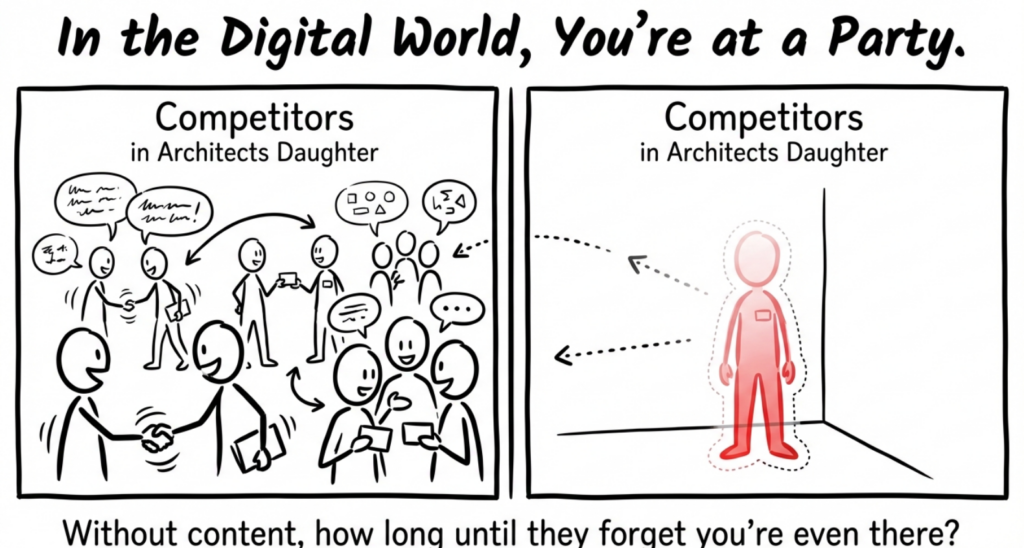
Imagine walking into a busy networking event. The room is buzzing. Competitors are shaking hands, sharing stories, and exchanging business cards.
You stand in the corner. You don’t speak. You don’t hand out a card. You don’t even wear a nametag.
How long until people forget you are even there?
In the digital world, this is exactly what happens when you stop publishing content. It isn’t just about missing out on “likes” or “clicks.” It is about fading from existence entirely.
The Core Concept: Why Silence Equals Erasure in AI Search
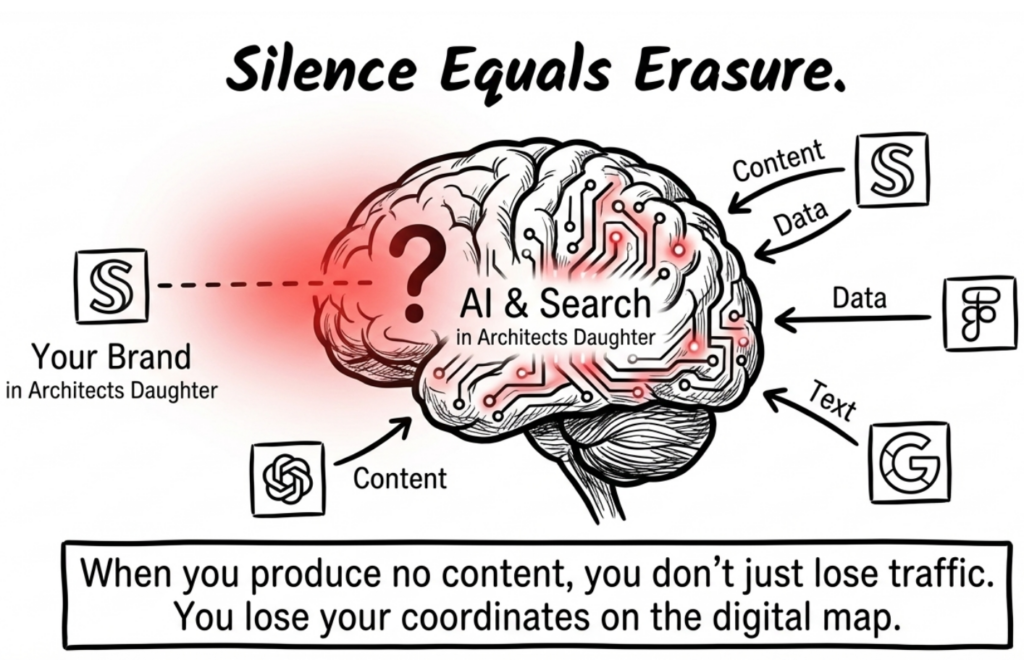
The Thesis: When your brand produces no content, you don’t just lose traffic. You lose your coordinates on the digital map.
Search engines and AI systems (like ChatGPT or Google Gemini) are not magic. They are voracious readers. They feed on content—text, visuals, data—to understand who you are, what you do, and why you matter. Without that signal, your brand is simply absent from the algorithm’s world.
4 Critical Mechanisms of Digital Erasure
If you stop publishing, you trigger a chain reaction that erases your brand. Here is how it happens, broken down by mechanism.
1. The Entity Gap: No Content = No Identity
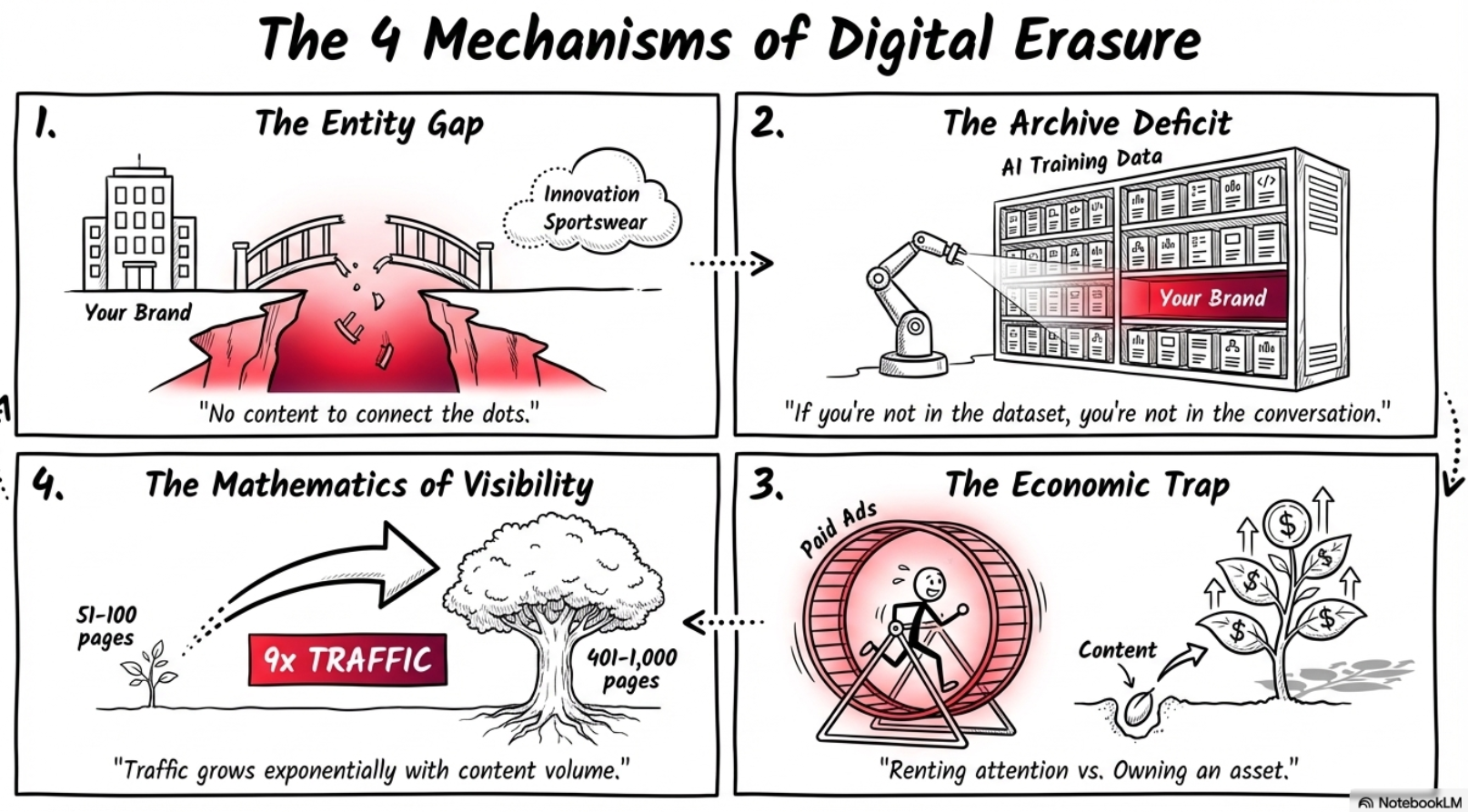
Modern search is based on Knowledge Graphs, not just keywords. It connects entities (Brands) to attributes (Topics).
- The Problem: If you sell “antibacterial running socks” but never write about the technology, Google cannot connect the dots between “Your Brand” → “Sportswear” → “Innovation.”
- The Result: Without content to bridge these entities, you become a ghost in the semantic web.
2. The Archive Deficit: Missing from AI Training Data
Search engines used to just index pages. Now, they archive knowledge. Every guide, case study, or article you publish becomes part of the web’s permanent memory—the same memory AI models train on.
- AI Retrieval Stat: Ahrefs found that 76.10% of pages cited in AI Overviews already rank in Google’s Top 10.
- The Implication: If you don’t rank, you don’t get cited. If you don’t publish, you don’t rank. If you aren’t in the dataset, you aren’t in the conversation.
3. The Mathematics of Visibility: Volume vs. Obscurity
Does volume matter? Yes. The data proves that “more content” lowers the barrier to discovery.
HubSpot Data on Content Volume:
- Traffic Impact: Sites with 401–1,000 web pages got 9× more traffic than sites with 51–100 pages.
- Lead Impact: Sites with 401–1,000 web pages got 6× more leads than sites with 51–100 pages.
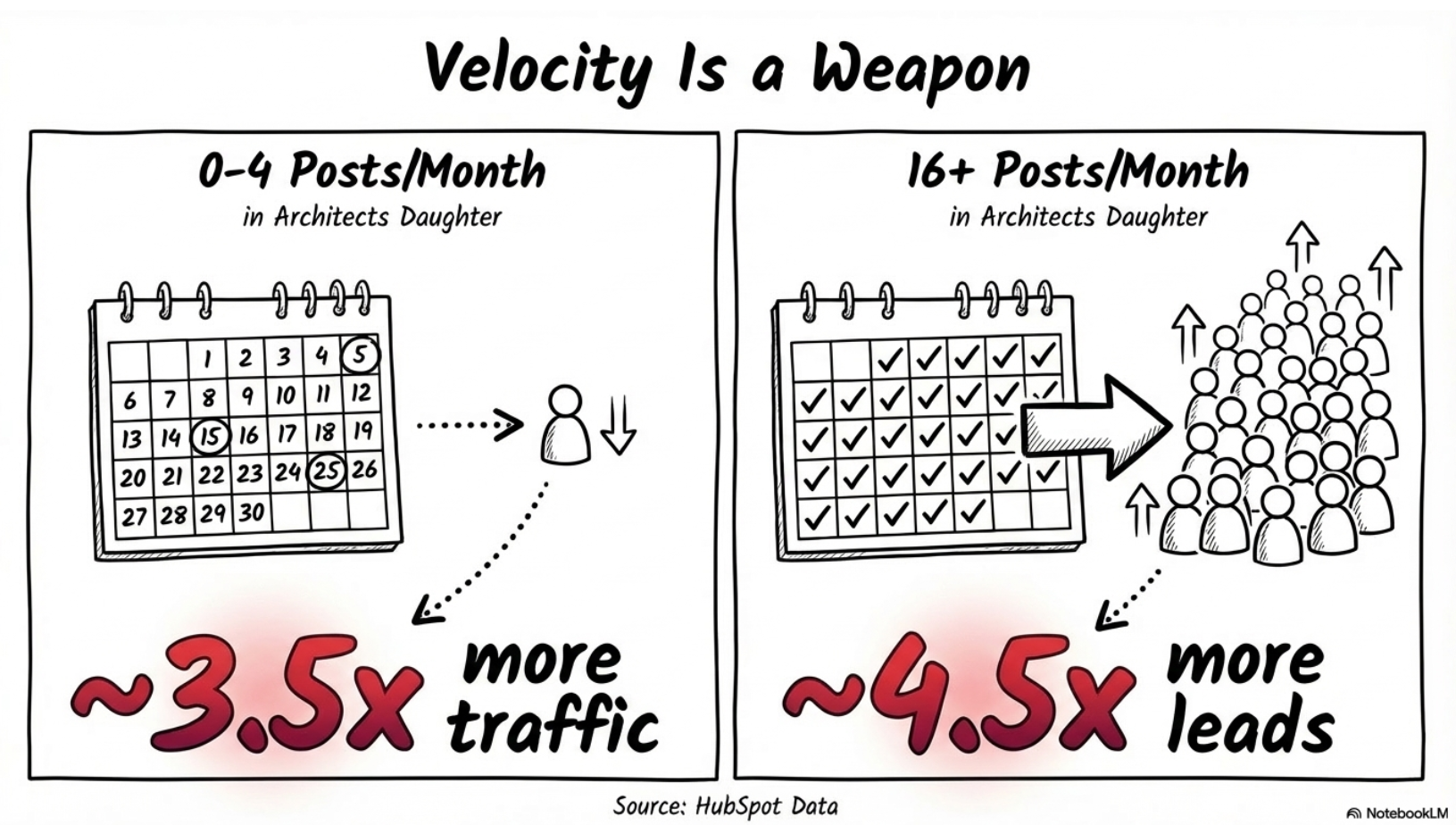
- Publishing Velocity: Publishing 16+ blog posts/month generated ~3.5× more traffic and ~4.5× more leads than publishing just 0–4.
The Bottom Line: More entry points = higher probability of existence.
4. The Economic Trap: Renting Ads vs. Owning Assets
This is the financial consequence of silence.
- Ads are Renting: You pay for attention. The moment your budget stops, the traffic stops.
- Content is Owning: A single post can attract backlinks and shares for years. It compounds.
- The “Silence Tax”: When you stop creating, you kill the compounding effect and are forced to rent attention forever via paid ads.
Comparative Analysis: Content-Rich vs. Content-Poor Website
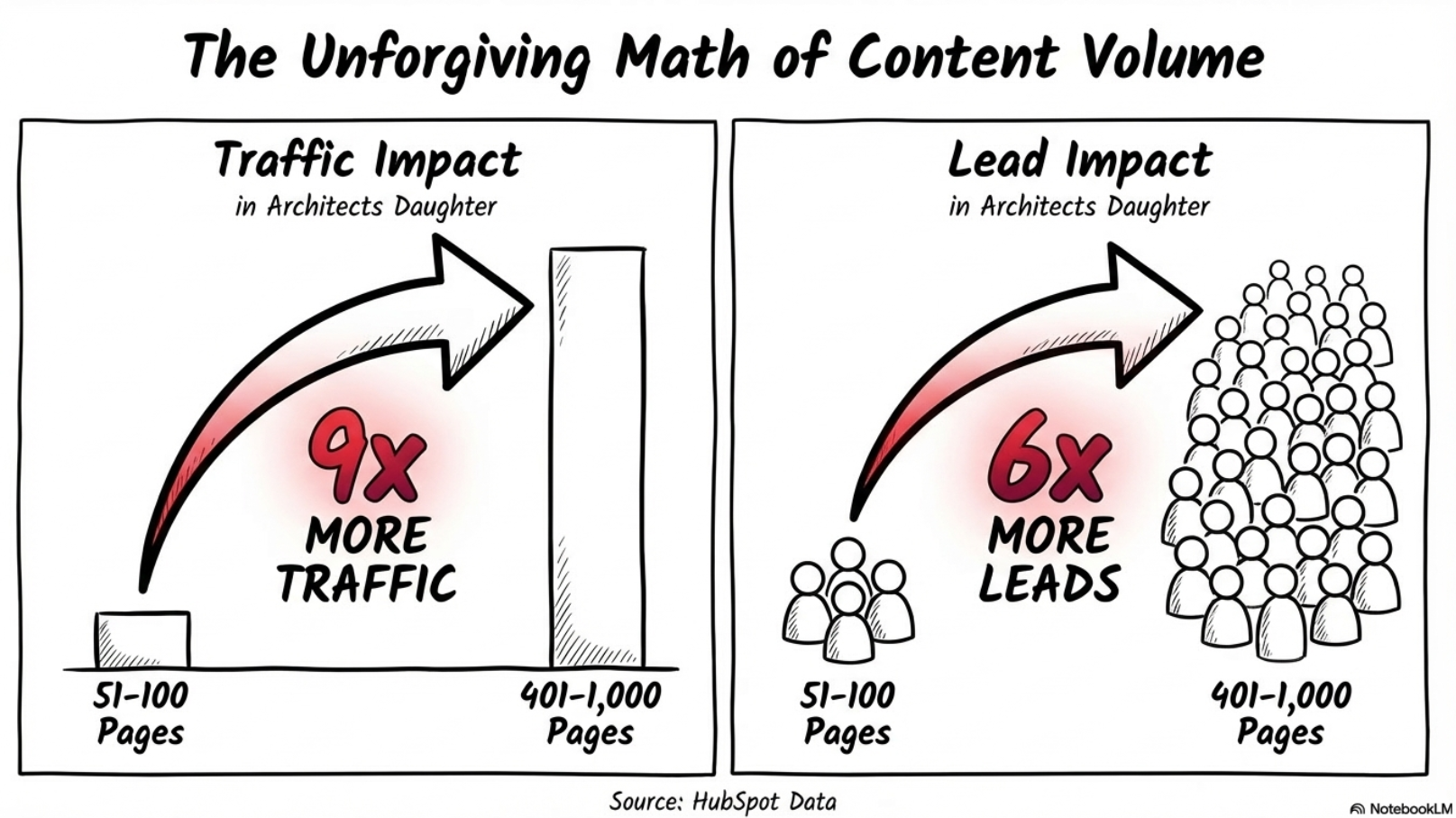
The difference between a “Content-Rich” site and a “Content-Poor” site is exponential.
| Dimension | Content-Rich Site (Many Pages + Posts) | Content-Poor Site (Few Pages, No Publishing) |
| Organic Traffic Potential | 9× more traffic (401–1,000 pages) (Source: HubSpot) | Low visibility Fewer indexable URLs = fewer surfaces |
| Lead Generation | 6× more leads (401–1,000 pages) (Source: HubSpot) | Weak conversion Fewer entry points for potential customers |
| “Content Library” Impact | 4.6× traffic / 3.5× leads (200+ posts) (Source: HubSpot) | No compounding Weak topical authority |
| Conversion Infrastructure | 12× more leads (40+ landing pages) (Source: HubSpot) | Missed opportunities Few landing pages = fewer targeted offers |
| Publishing Velocity | ~4.5× more leads (16+ posts/month) (Source: HubSpot) | Slow discovery Fewer freshness signals |
| AI Visibility | High chance to be cited (Top-10 heavy) (Source: Ahrefs) | Near zero chance If you don’t rank, AI ignores you |
The BlackGrid Framework: The 5 Layers of Content Impact
Here is the breakdown of what silence actually costs you across every layer of your business structure.
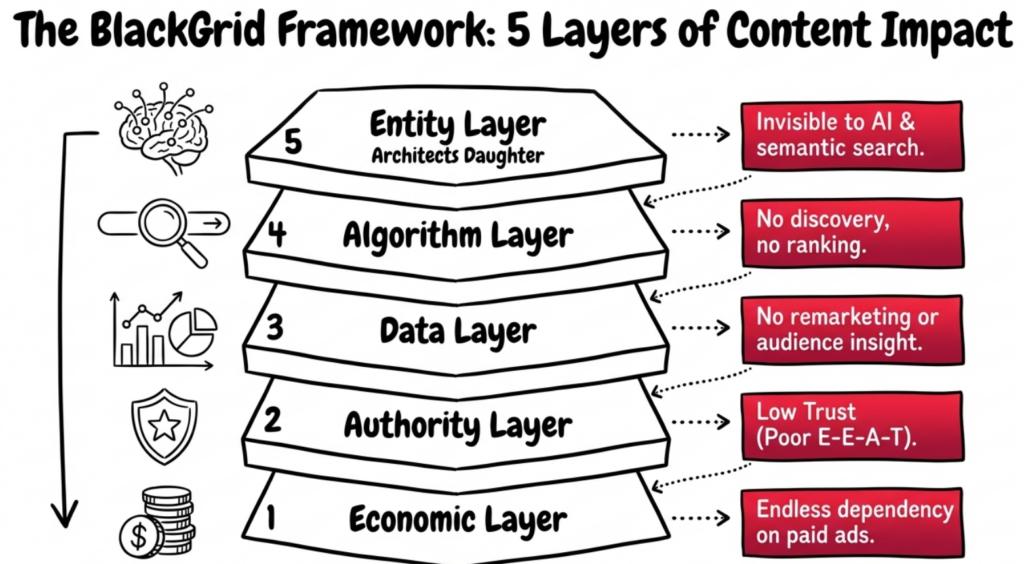
| Layer | What “No Content” Means | The Consequence |
| Entity Layer | No topics tied to your brand | Invisible to AI & semantic search |
| Algorithm Layer | No engagement data | No discovery, no ranking |
| Data Layer | No tracking or pixels | No remarketing or audience insight |
| Authority Layer | No proof of expertise | Low Trust (Low E-E-A-T scores) |
| Economic Layer | No compounding effect | Endless dependency on paid ads |
FAQ: The Content Reality Check
1) Does “more content” really mean more leads?
Yes. HubSpot found that sites with 401–1,000 pages generate 6× more leads than sites with 51–100 pages. More pages mean more entry points.
2) How many pages is “enough” to start seeing impact?
HubSpot data shows big jumps at scale. Moving from 51–100 pages to 401–1,000 pages creates a massive multiplier effect for leads and traffic.
3) What kind of “content” matters most for discoverability?
Any indexable asset that maps to customer intent: blog posts, landing pages, FAQs, guides, and case studies. Internal links connecting them (Topic Clusters) are critical for authority.
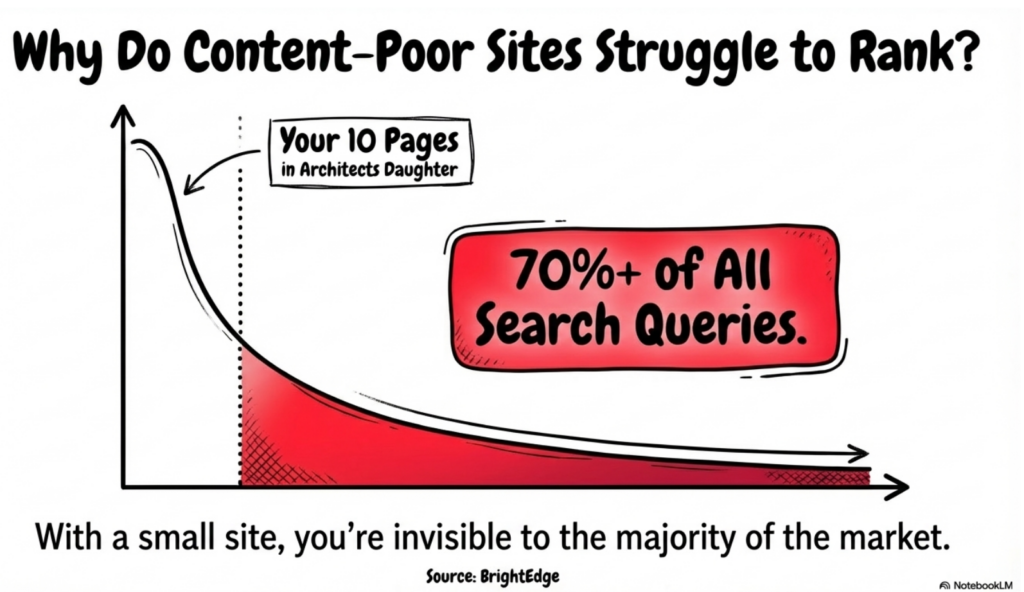
4) Why does a content-poor site struggle to rank?
Because it lacks “Topical Authority.” It also misses the long tail. BrightEdge reports that 70%+ of search queries are long-tail, which requires many specific pages to capture. If you only have 10 pages, you miss 70% of the market.
5) How does content help AI systems “understand” a brand?
Your content provides the entity relationships (Brand → Category → Attributes). Without this text, AI models like Gemini or ChatGPT cannot “learn” who you are.
6) Does frequent publishing help vs. publishing a few times a year?
Yes. Publishing 16+ posts/month correlates with ~3.5× traffic and ~4.5× leads compared to publishing 0–4 posts/month. Frequency signals relevance.
7) Does content affect whether you appear in AI summaries/AI Overviews?
Absolutely. Ahrefs found that 76.10% of pages cited in AI Overviews are from the Top 10 search results. If you don’t publish enough to rank, you won’t be cited by AI.
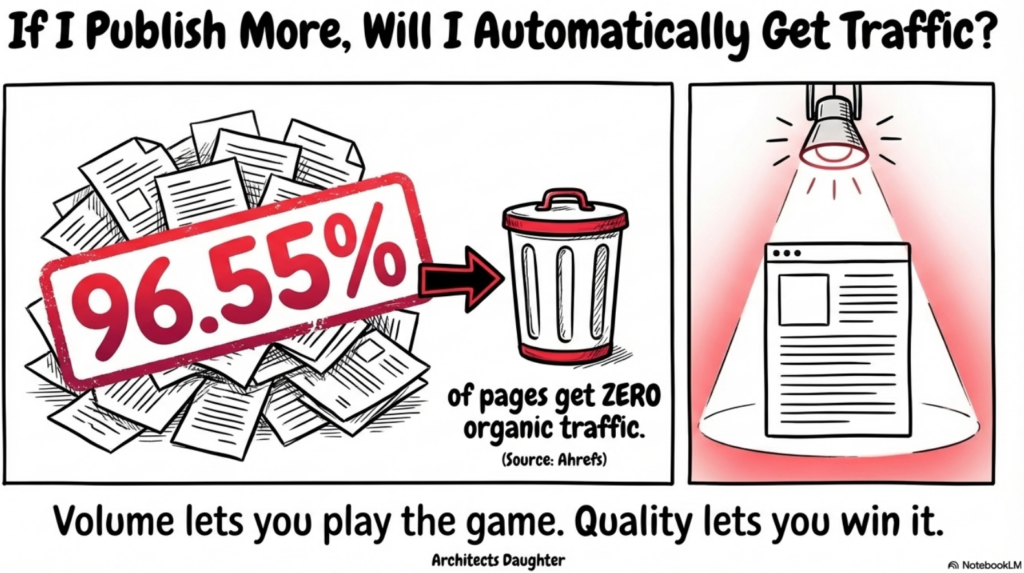
8) If I publish content, will it automatically get traffic?
No. Ahrefs found 96.55% of pages get zero organic traffic. Content must be high-quality, intent-matched, and internally linked to work. Volume allows you to play the game, but quality allows you to win it.
The Final Verdict: Content Is Your Digital DNA
Content isn’t just marketing fluff. It is your Digital DNA.
Every word, every image, and every schema tag is a fragment of your existence in the algorithmic universe. In the AI era, no content means no coordinates on the map.
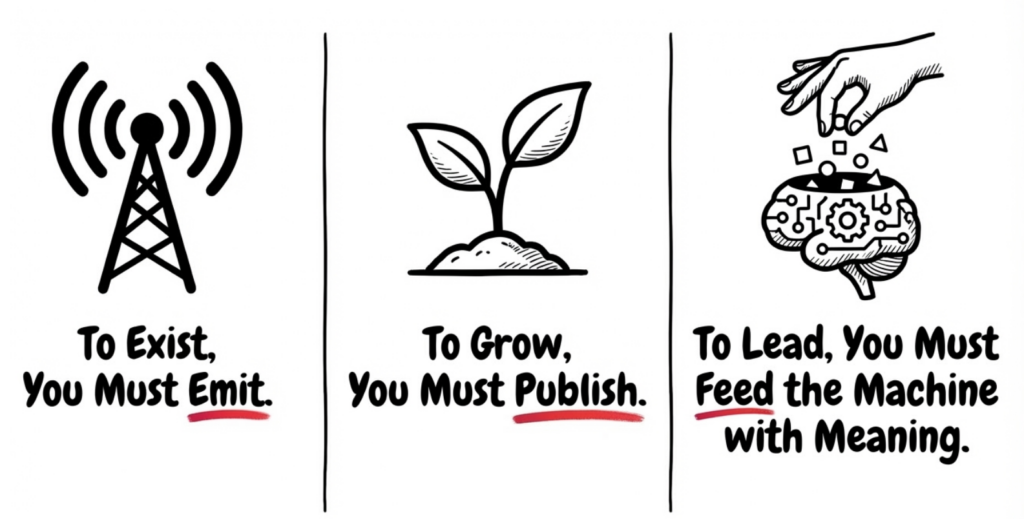
- To exist, you must emit.
- To grow, you must publish.
- To lead, you must feed the machine with meaning.
That is the BlackGrid way of thinking—content not as “copy,” but as code for visibility, trust, and permanence.