
The Hidden Cost of Standing Still: Why Content Decay Eats Authority Alive
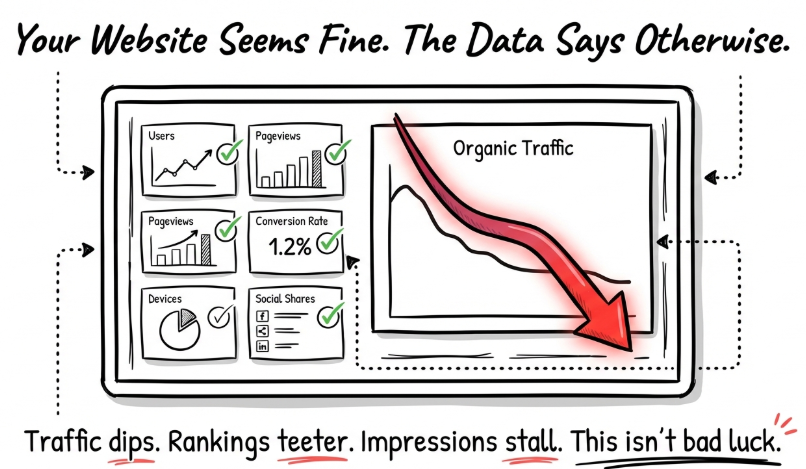
Picture this. Your website looks sharp. Your design feels current. Your content seems solid. But when you dive into the analytics, the numbers tell a different story. Traffic dips. Rankings teeter. Impressions stall.
That isn’t bad luck. That is Content Decay.
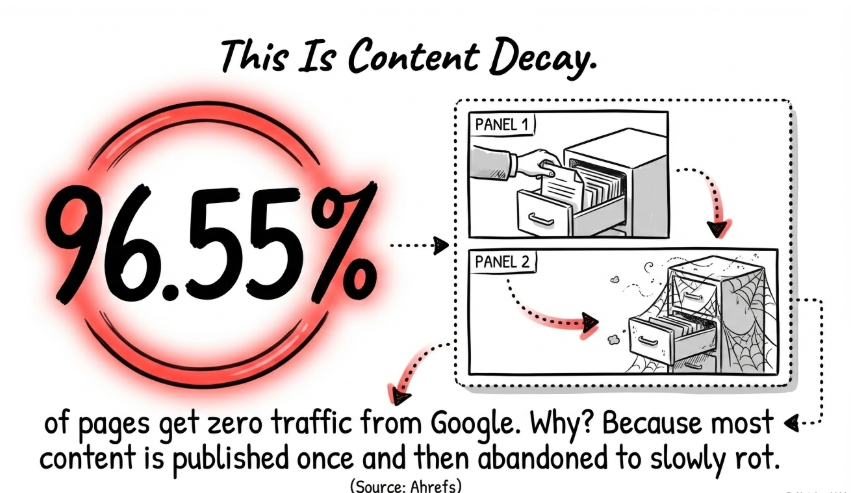
It is the invisible erosion of visibility that happens when your once-powerful pages lose sync with the real world. According to Ahrefs, 96.55% of pages in their index get zero traffic from Google. Why? Because most content is published once and then abandoned to slowly rot.
The Real Meaning of Content Decay
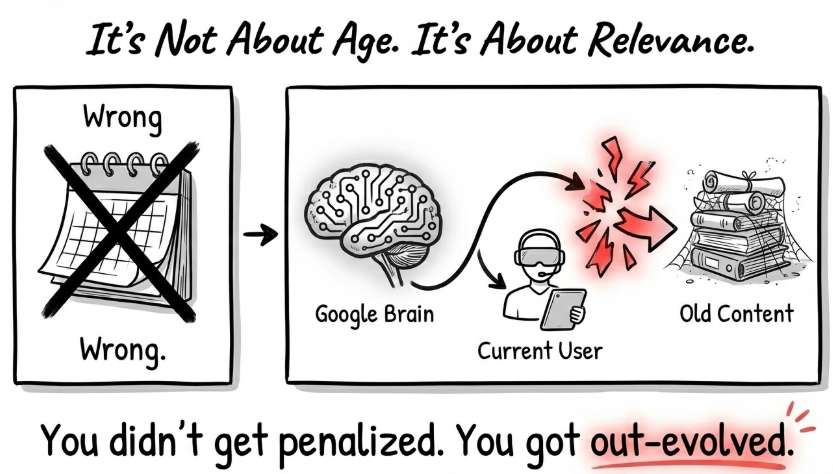
Let’s cut through the noise: Content Decay isn’t about age—it’s about relevance.
Search engines are living systems that evolve every day. Google explicitly states that its “freshness” systems are designed to surface current content, a change that affected ~35% of searches when first introduced.
Take your article on “best running socks” that used to rank #1. It didn’t suddenly become “wrong.” It just started speaking an outdated dialect. The result? You didn’t get penalized. You got out-evolved.
The Tale of Two Websites: Dynamic vs. Dormant
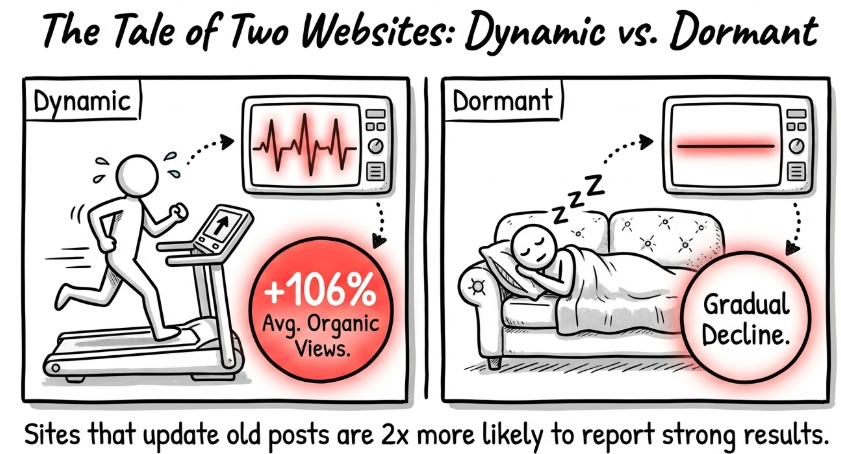
The difference between a site that grows and a site that stagnates often comes down to one thing: Frequency.
The data is clear. Websites that maintain a “heartbeat” of updates vastly outperform those that treat their blog like a storage unit.
| Feature | Dynamic Sites (Frequent Updates) | Dormant Sites (Irregular / Forget) |
| Probability of “Strong Results” | 57% (Daily publishing) ~38% (2–6x/week) | ~11% (Irregular cadence) |
| Impact of Updating Old Posts | 2x more likely to report strong results | Performance slowly drifts down as competitors update |
| Typical Traffic Lift | +106% avg. organic views on updated posts | 0% (Gradual decline due to intent shift) |
| Risk Exposure | Aligned with Google’s Freshness Systems | High risk of being “out-evolved” by fresh competitors |
(Data Sources: Orbit Media, Crazy Egg, HubSpot, Search Engine Journal)
What Is Really Happening Under the Hood?
To fight decay, you have to understand the invisible mechanics that steal your traffic:
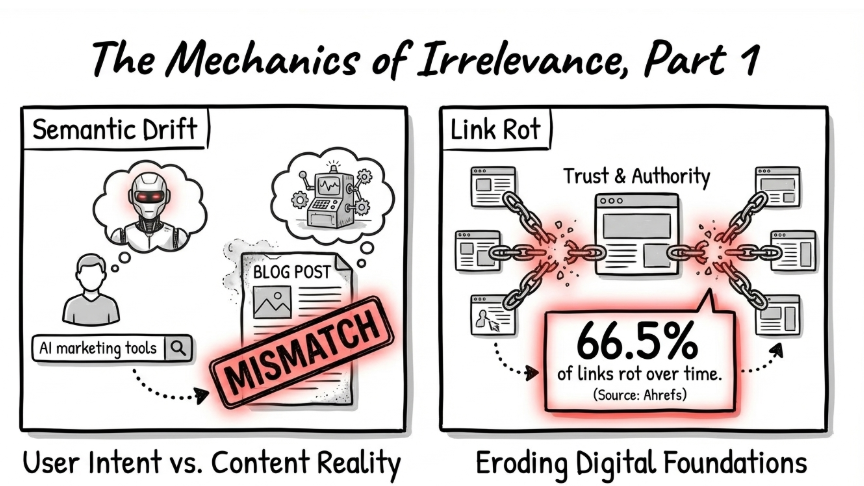
- Semantic Drift (The Language Gap): The way people search changes faster than your editorial calendar. A phrase like “AI marketing tools” used to mean simple automation software; now it implies full generative ecosystems. If your page still speaks yesterday’s meaning, you become invisible in today’s results.
- The Trust Shuffle & Link Rot: Google quietly moves authority away from sites that lack “E-E-A-T” signals. A major culprit here is Link Rot. Ahrefs found that 66.5% of links pointing to websites had “rotted” over time. When your external references break, your trust score crumbles. No slap, no alert. Just silence.
- Fighting Yourself (Cannibalization): When you publish without structure, your pages start competing with each other. Instead of building one strong signal, you split your authority across five weak pages. It is friendly fire, and it destroys your rankings.
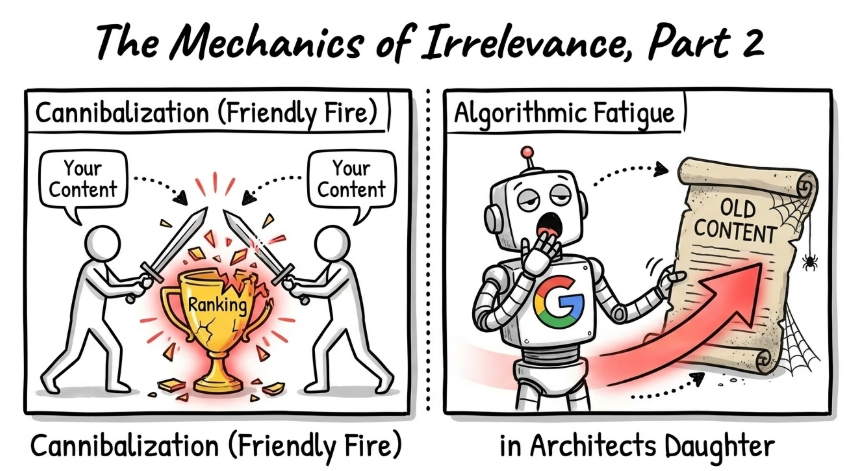
- Algorithmic Fatigue: Modern algorithms crave intent and authentic experience. If your content reads like a keyword-stuffed relic from 2019, the algorithm simply scrolls right past it.
The Trap: Decay Hides in Plain Sight
This is what makes content decay dangerous: it hides.
One fast-growing page can easily mask five others that are silently dying. You need to treat your content like a software product. Your goal isn’t just “more pages”—it is maintaining a healthy flow of authority, the lifeblood of your entire organic ecosystem.
Refreshing Is Repositioning (Not Just Rewriting)
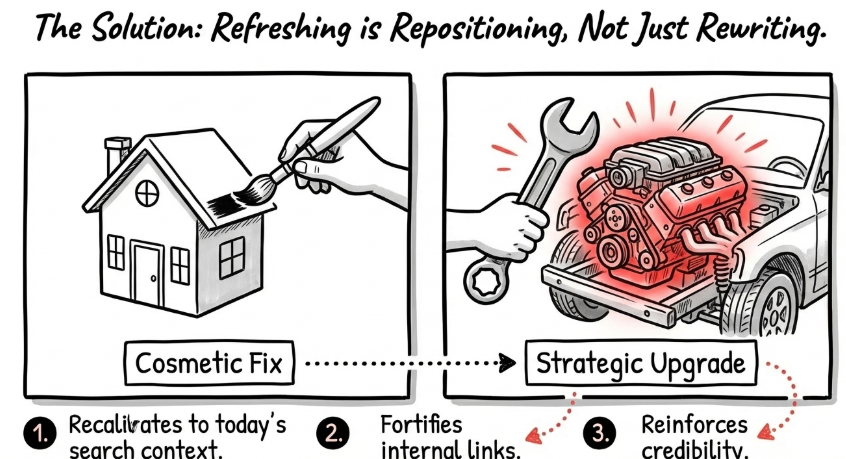
Updating isn’t cosmetic; it is strategic. A real refresh is not just adding a new paragraph—it is repositioning meaning.
A smart update does three things:
- Recalibrates: It aligns your content with today’s search context.
- Fortifies: It fixes your internal links to restore cohesion.
- Reinforces: It signals to Google, “We are alive, we are current, we are credible.”
Does it work? Absolutely.
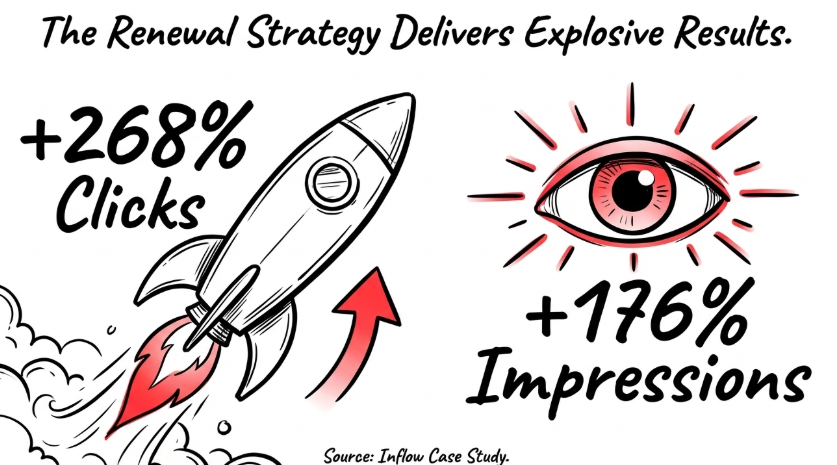
- Inflow Case Study: Reported a +268% increase in organic clicks and +176% in impressions after refreshing key pages.
- HubSpot Data: When they optimized old content, monthly organic search views for those posts increased by an average of 106%, and monthly leads more than doubled.
Why Frequent Publishing Keeps You Algorithm-Proof
Think of every new article as a pulse in your site’s heartbeat. Frequent publishing isn’t vanity. It is maintenance.
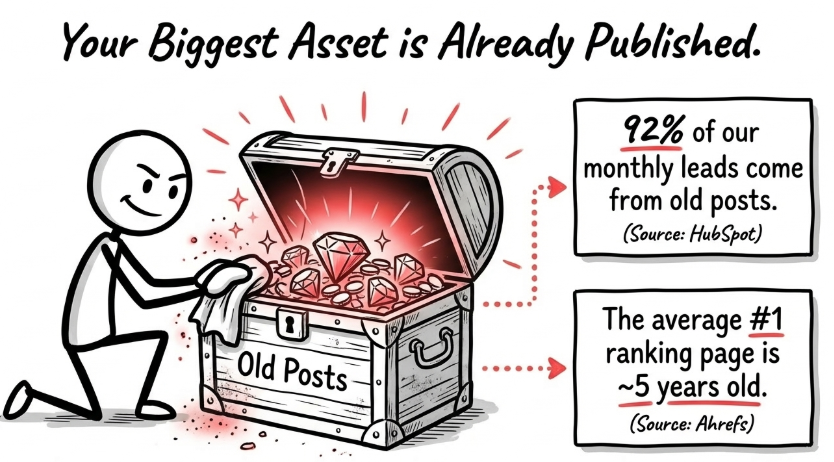
If you doubt the value of your “old” content, look at the reality of the Search Engine Results Page (SERP). Ahrefs found that 72.9% of the Top 10 URLs were older than 3 years, and the #1 ranking page averages about 5 years old.
Old content is your biggest asset, but only if you polish it. HubSpot found that 76% of their monthly blog views came from older posts, and those same posts generated 92% of their monthly leads.
Freshness is your only defense against fatigue. It is your fuel for sustained authority.
FAQ: Everything You Need to Know About Content Decay
1) What is content decay in SEO?
Content decay is the gradual decline of a page’s organic performance (rankings, impressions, CTR, clicks) as it becomes less aligned with search intent, freshness expectations, and competitor improvements.
2) What causes content decay?
The three main drivers are Semantic Drift (language changes), Competition (others publishing better content), and Algorithm Updates (shifts in how Google values trust signals).
3) How do I know if a page is decaying?
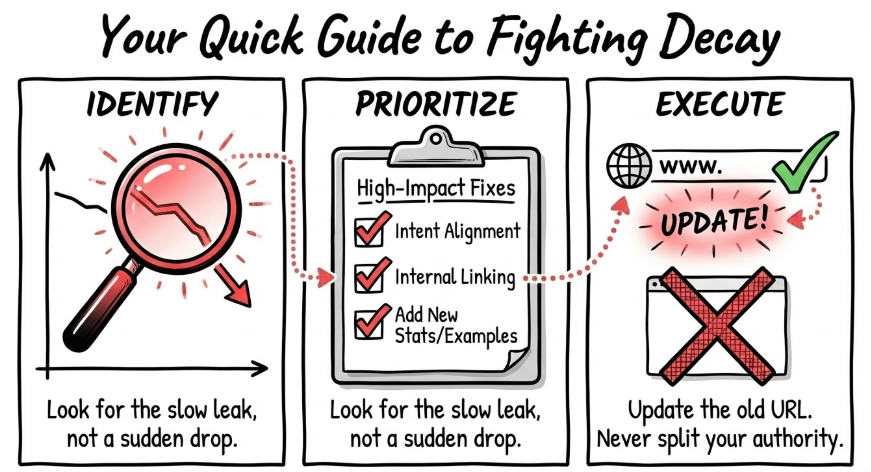
Look for the “slow leak.” A sudden drop is usually a penalty or technical error. Decay looks like a gradual slide in impressions first, followed by a drop in average position, and finally a decline in traffic.
4) What’s the difference between content decay vs. seasonal traffic changes?
Seasonality is a cycle (traffic returns next year). Decay is a downward trend that does not recover on its own.
5) Does Google reward updated content automatically?
Yes, for many queries. Google’s “Query Deserves Freshness” (QDF) system specifically looks for up-to-date information. If your content is stale, these systems will demote it in favor of fresher pages.
6) How often should I refresh blog posts for SEO?
It depends on volatility. High-competition topics might need quarterly updates. Evergreen guides might only need annual checks.
7) Should I update an old URL or create a new one?
Update the old URL. It already has link equity and history. Creating a new URL for the same topic splits your authority (cannibalization) and forces you to start from zero.
8) What are the highest-impact fixes for content decay?
- Intent Alignment: Ensure the article answers the question users are asking today.
- Internal Linking: Point new, strong pages to the decaying page.
- Entities: Add missing subtopics and modern examples.
- Multimedia: Add new charts or images to increase engagement.
9) Can updating content improve clicks and impressions?
Yes. Inflow’s case study showed a massive +268% increase in clicks and +176% in impressions simply by refreshing existing content.
10) Is it better to publish new content or refresh old content?
You need both, but refreshing often has a higher ROI. HubSpot found that 92% of their leads came from old posts. Ignoring them is leaving money on the table.
11) How does E-E-A-T affect decaying pages?
Old pages often lack modern trust signals. Adding current citations, a verified author bio, and a “Last Updated” date signals to Google that the content is still trustworthy and managed by experts.
12) What is keyword cannibalization and how does it accelerate decay?
Cannibalization happens when you write a new post that covers the same topic as an old post. Google doesn’t know which one to rank, so it often ranks neither. Refreshing the old post is usually the better strategy.
13) How do topic clusters and internal linking reduce decay risk?
They create a web of relevance. If one page decays, it can drag down the whole cluster. Conversely, updating a “pillar” page can send fresh authority signals to all the linked supporting posts.
14) Why do older pages still dominate Google—but still need updates?
The #1 ranking page is typically ~5 years old (Ahrefs). Age gives authority, but updates keep that authority relevant. The winners are “old” pages that are frequently maintained, not “old” pages that are abandoned.
15) Why do so many pages get zero traffic?
Ahrefs reports that 96.55% of pages get zero traffic. This is usually because they lack backlinks, target no search intent, or have decayed to the point of irrelevance.
16) What should I update first: stats, sections, headings, schema, or CTAs?
Start with Stats and Facts (accuracy), then Headings (intent matching), then Schema (technical clarity).
17) How do I track refresh ROI in Google Search Console?
Use the “Compare” feature in GSC. Compare the 3 months before the update to the 3 months after. Look for lifts in Average Position and CTR specifically.
18) Do content updates help with AI Overviews / answer engines?
Yes. AI models prioritize current, factual information. Stale content is less likely to be cited in an AI-generated summary because the model detects it as outdated.
The Final Verdict: Dynamic vs. Dormant
Every brand pays the “Content Decay Tax” eventually—whether through lost traffic, diluted trust, or eroded authority.
But brands that commit to a steady rhythm of publishing and refreshing send one unmistakable signal to both search engines and audiences: “We are dynamic, not dormant.”
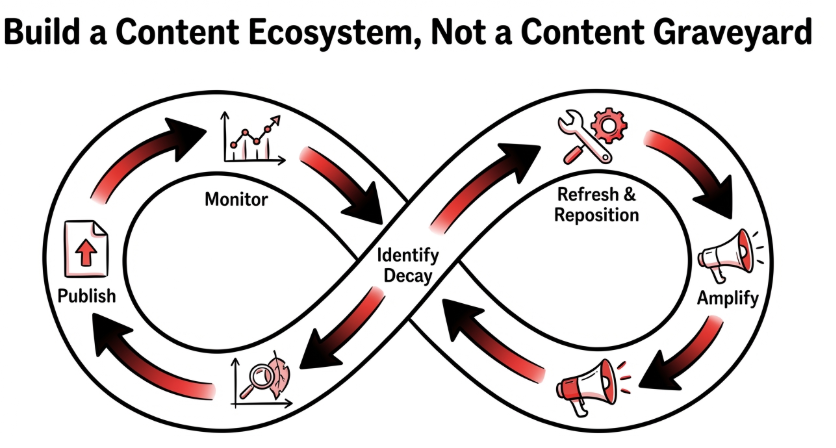
At BlackGridSEO, we call this the Content Ecosystem Loop. It is a living system where every update compounds your trust and amplifies your exposure.
Because in the age of modern SEO, your edge isn’t just in what you say—it’s in how consistently you prove you’re still learning, evolving, and leading.